Book Corner:
Digital Design Essentials
100 Ways to Design Better Desktop, Web, and Mobile Interfaces
Mar. 31, 2014
by Nathaniel Steier
Intro
This post is entitled "Book Corner" because I didn't think it is fair to call this an impartial "review". It is more a "first impression", or just a plain ramble.
Digital Design Essentials
100 Ways to Design Bettter Desktop, Web, and Mobile Interfaces
by Rajesh Lal
Publisher: Rockport Publishers (June 1, 2013)
ISBN-10: 1592538037
ISBN-13: 978-1592538034
In the "Acknowledgements" section, the author mentions "two of the most influential people in the design world who have shaped my thinking on design"1:
- Steve Jobs
- Marko Ahtisaari
The name "Steve Jobs" I recognized from Apple. Personally, in terms of design, I think the "other" Steve, Mr. Wozniak, is the unsung hero. The book "Hackers: Heroes of the Computer Revolution" by Steven Levy tells a fascinating tale of computer history, including segments on the two Steves, Mr. Bill, and a whole host of others2. The name "Marko Ahtisaari", the Nokia design chief, I was unfamiliar with.
The Good (Chapters)
- User Interface (Human-Computer Interface)
- WIMP Interface
- Interactive Voice Response (IVR) System
The Bad (Chapters)
- Organic User Interface
- Mashup App
- Web 2.0 User Interface Design
The Ugly (Chapters)
The example cites "Alpine (Email Client)" but doesn't make a reference to the original Pine program. (I know, I know...I'm being pedantic.)
Why?
The bane of content on the Internet.
- Command Line Interface (CLI)
- Rating App
- Banner Ad
References
1. Lal, Raj "Digital Design Essentials: 100 Ways to Design Bettter Desktop, Web, and Mobile Interfaces". Beverly, MA: Rockport Publishers; 2013:203. ↩
2. Levy, Steven "Hackers: Heroes of the Computer Revolution". Garden City, NY: Doubleday; 1984. ↩
Random Thought Of The Day:
Portable Office
Mar. 5, 2014
by Nathaniel Steier
Intro
On April 19, 1965, Gordon Moore published a paper "Cramming More Components onto Integrated Circuits". He would later be credited with "Moore's Law", an observation that chip performance will double every 18 months. In this original paper, he noted: 1
The complexity for minimum component costs has increased at a rate of roughly a factor of two per year.
Later, the timeline would be modified to two years and eighteen months. Regardless, Mr. Moore was spot on when he stated: 1
Integrated electronics will make electronic techniques more generally available throughout all of society, performing many functions that presently are done inadequately by other techniques or not done at all.
Hardware
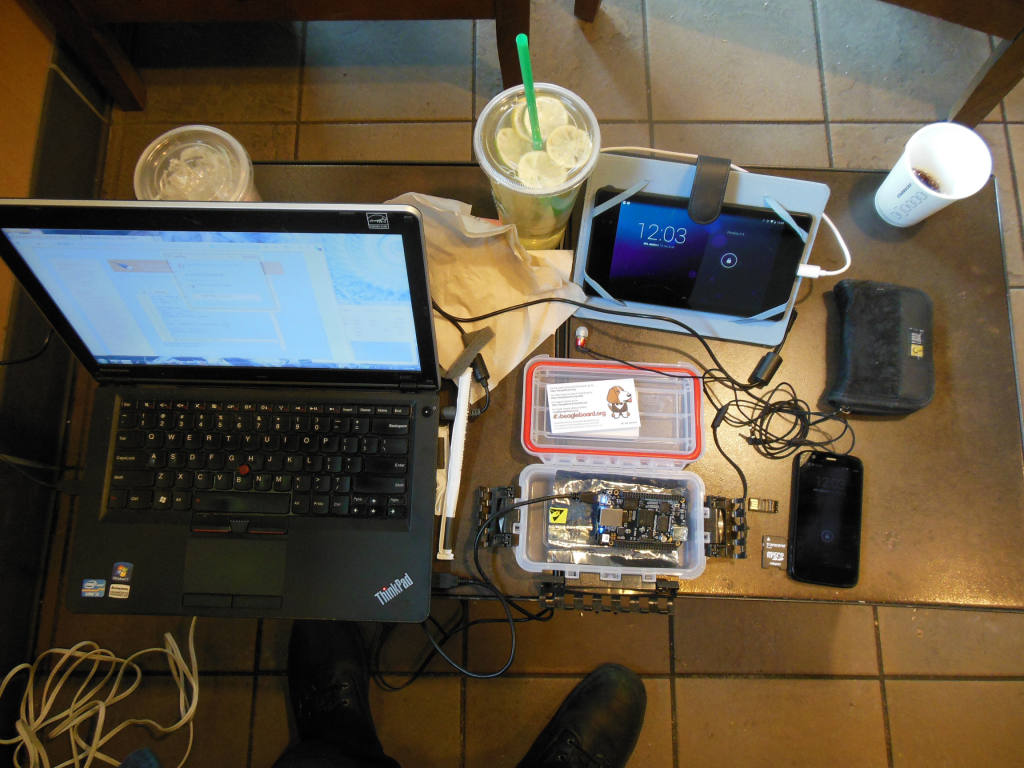
In the attached picture, there are four devices that make up this "portable office":
- Lenovo i3-CPU laptop
- Motorola/Google Moto G smartphone
- Asus Nexus 7 (2013) tablet
- BeagleBone Black embedded development board
Description
Some other interesting tidbits:
- Three operating systems:
- Windows 7 on the laptop
- Android 4.4 KitKat
- Ångström Linux Linux on the BeagleBone Black
- The phone has the ability to tether, and act as a WiFi antenna for the devices.
- The BeagleBone Black has an Ethernet (wired) port, but currently not wireless capabilities. However, it is can tether to the laptop via USB.
- A web server is running on two of the devices:
- laptop - Apache
- BeagleBone Black - nodeJS
- HDMI Video Outputs:
- Miniplug (1/8" jack) Audio Ouput
- laptop
- tablet
- smartphone
- BeagleBone Black
- Sensors
On top of all this, everything is networkable! This certainly creates a world of possibilities.
I'll end this with Mr. Moore's quote: 1
Clearly, we will be able to build such component-crammed equipment. Next, we ask under what circumstances we should do it.
References
1. Moore, Gordon E. "Cramming More Components onto Integrated Circuits". Electronics. April 19, 1965; Vol 38 Num 8: pp. 114–117. ↩ |
 |